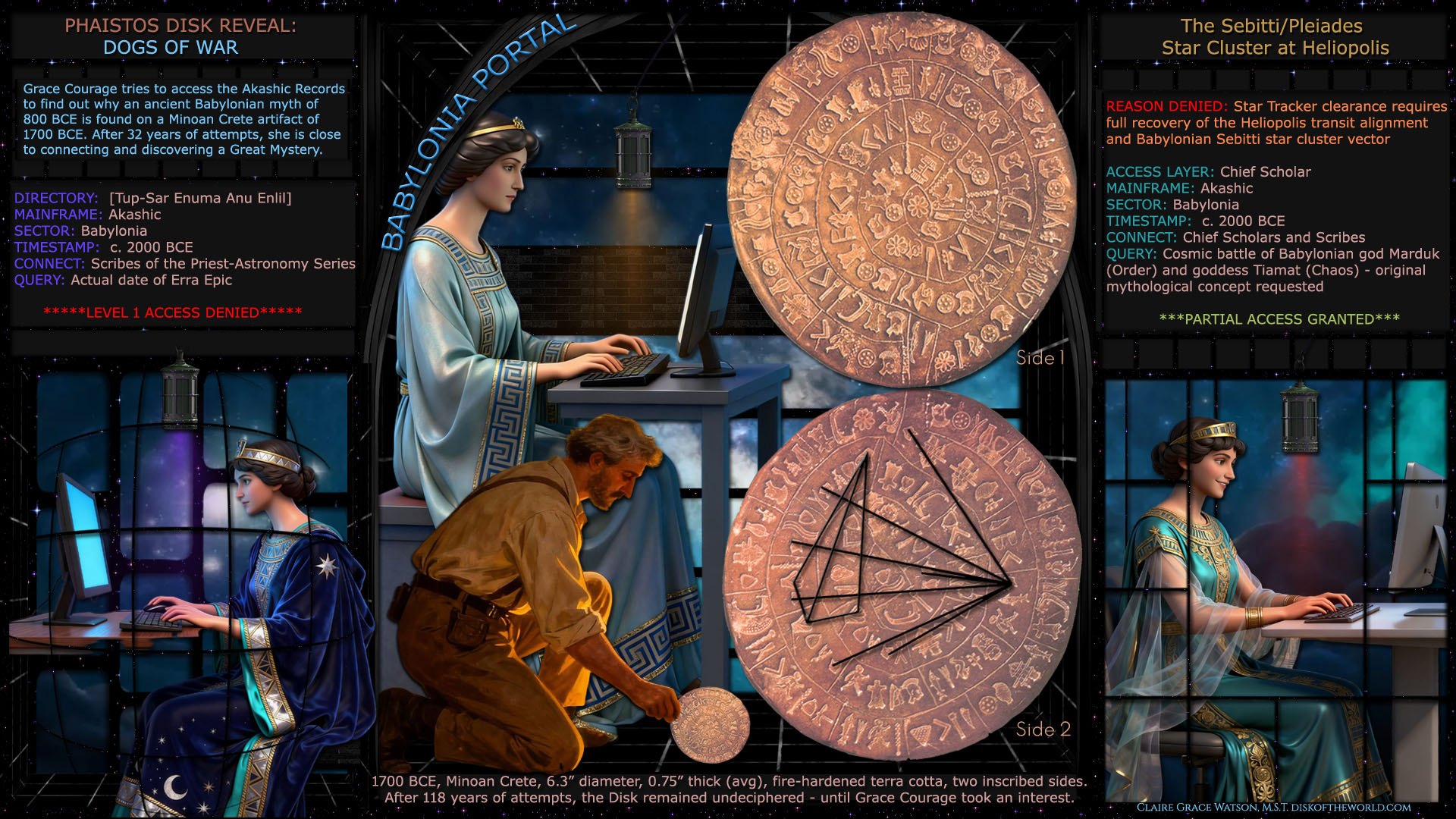
1700 BCE, Minoan Crete, 6.3" diameter, 0.75" thick (avg), fire-hardened terra cotta, two inscribed sides. After 118 years of attempts, the Disk remained undeciphered - until Grace Courage took an interest.
Grace Courage tries to access the Akashic Records to find out why an ancient Babylonian myth of 800 BCE is found on a Minoan Crete artifact of 1700 BCE. After 32 years of attempts, she is close to connecting and discovering a Great Mystery.
DIRECTORY: [Tup-Sar Enuma Anu Enlil]
MAINFRAME: Akashic
SECTOR: Babylonia
TIMESTAMP: c. 2000 BCE
CONNECT: Scribes of the Priest-Astronomy Series
QUERY: Actual date of Erra Epic
*****LEVEL 1 ACCESS DENIED*****
REASON DENIED:
ACCESS LAYER: Chief Scholar
MAINFRAME: Akashic
SECTOR: Babylonia
TIMESTAMP: c. 2000 BCE
CONNECT: Chief Scholars and Scribes
QUERY: Cosmic battle of Babylonian god Marduk (Order) and goddess Tiamat (Chaos) - original mythological concept requested
***PARTIAL ACCESS GRANTED***
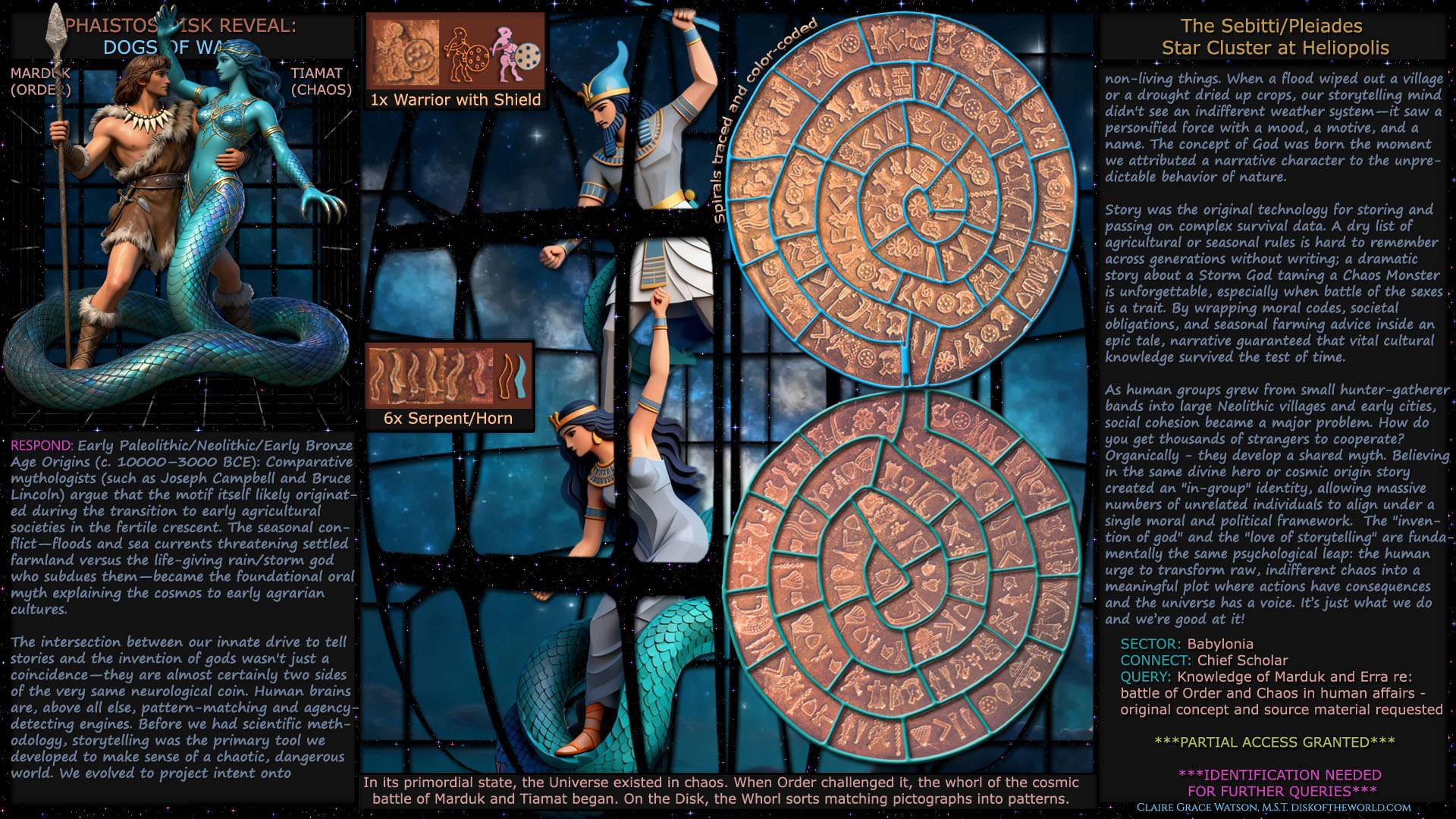
In its primordial state, the Universe existed in chaos. When Order challenged it, the whorl of the cosmic battle of Marduk and Tiamat began. On the Disk, the Whorl sorts matching pictographs into patterns.
RESPOND: Early Paleolithic/Neolithic/Early Bronze Age Origins (c. 10000-3000 BCE): Comparative mythologists (such as Joseph Campbell and Bruce Lincoln) argue that the motif itself likely originated during the transition to early agricultural societies in the fertile crescent. The seasonal conflict--floods and sea currents threatening settled farmland versus the life-giving rain/storm god who subdues them--became the foundational oral myth explaining the cosmos to early agrarian cultures.
The intersection between our innate drive to tell stories and the invention of gods wasn't just a coincidence--they are almost certainly two sides of the very same neurological coin. Human brains are, above all else, pattern-matching and agency-detecting engines. Before we had scientific methodology, storytelling was the primary tool we developed to make sense of a chaotic, dangerous world.
We evolved to project intent onto non-living things. When a flood wiped out a village or a drought dried up crops, our storytelling mind didn't see an indifferent weather system--it saw a personified force with a mood, a motive, and a name. The concept of God was born the moment we attributed a narrative character to the unpredictable behavior of nature.
Story was the original technology for storing and passing on complex survival data. A dry list of agricultural or seasonal rules is hard to remember across generations without writing; a dramatic story about a Storm God taming a Chaos Monster is unforgettable, especially when battle of the sexesis a trait. By wrapping moral codes, societal obligations, and seasonal farming advice inside an epic tale, narrative guaranteed that vital cultural knowledge survived the test of time.
As human groups grew from small hunter-gatherer bands into large Neolithic villages and early cities, social cohesion became a major problem. How do you get thousands of strangers to cooperate? Organically - they develop a shared myth. Believing in the same divine hero or cosmic origin story created an "in-group" identity, allowing massive numbers of unrelated individuals to align under a single moral and political framework. The "invention of god" and the "love of storytelling" are fundamentally the same psychological leap: the human urge to transform raw, indifferent chaos into a meaningful plot where actions have consequences and the universe has a voice. It's just what we do and we're good at it!
SECTOR: Babylonia
CONNECT: Chief Scholar
QUERY: Knowledge of Marduk and Erra re: battle of Order and Chaos in human affairs - original concept and source material requested
* ***PARTIAL ACCESS GRANTED***
***IDENTIFICATION NEEDED FOR FURTHER QUERIES***
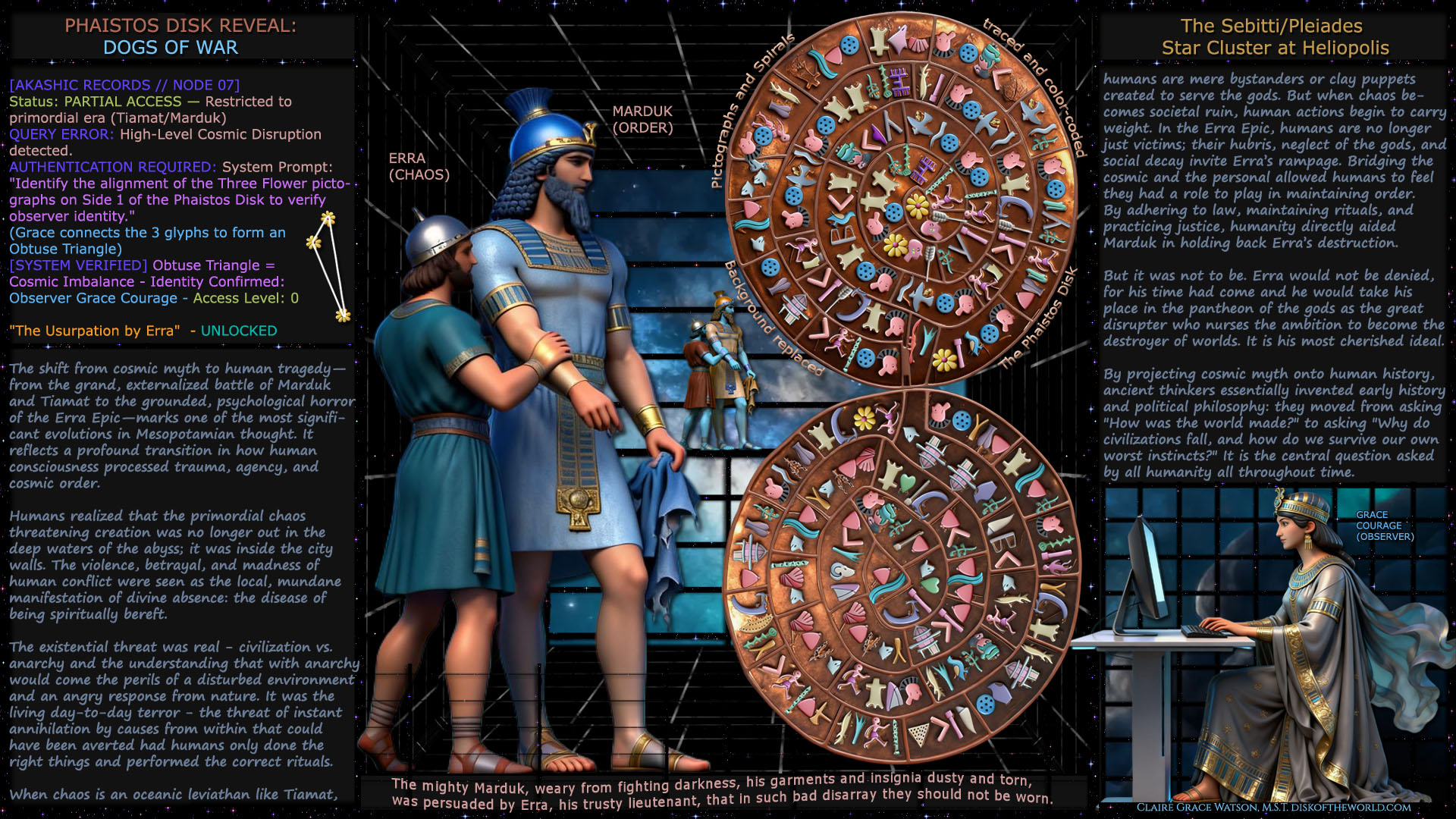
(Lyrics): The mighty Marduk, weary from fighting darkness, his garments and insignia dusty and torn, was persuaded by Erra, his trusty lieutenant, that in such bad disarray they should not be worn.
[AKASHIC RECORDS // NODE 07]
Status: * PARTIAL ACCESS -- Restricted to primordial era (Tiamat/Marduk)
QUERY ERROR: High-Level Cosmic Disruption detected.
AUTHENTICATION REQUIRED: System Prompt: "Identify the alignment of the Three Flower pictographs on Side 1 of the Phaistos Disk to verify observer identity." (Grace connects the 3 glyphs to form an Obtuse Triangle)
[SYSTEM VERIFIED] Obtuse Triangle =Cosmic Imbalance - Identity Confirmed:
Observer Grace Courage - * Access Level: 0
"The Usurpation by Erra" - UNLOCKED
The shift from cosmic myth to human tragedy--from the grand, externalized battle of Marduk and Tiamat to the grounded, psychological horror of the Erra Epic--marks one of the most significant evolutions in Mesopotamian thought. It reflects a profound transition in how human consciousness processed trauma, agency, and cosmic order.
Humans realized that the primordial chaos threatening creation was no longer out in the deep waters of the abyss; it was inside the city walls. The violence, betrayal, and madness of human conflict were seen as the local, mundane manifestation of divine absence: the disease ofbeing spiritually bereft.
The existential threat was real - civilization vs.anarchy and the understanding that with anarchywould come the perils of a disturbed environmentand an angry response from nature. It was the living day-to-day terror--the threat of instantannihilation by causes from within that could have been averted had humans only done the right things and performed the correct rituals.
When chaos is an oceanic leviathan like Tiamat, humans are mere bystanders or clay puppets created to serve the gods. But when chaos becomes societal ruin, human actions begin to carry weight. In the Erra Epic, humans are no longer just victims; their hubris, neglect of the gods, andsocial decay invite Erra's rampage. Bridging the cosmic and the personal allowed humans to feel they had a role to play in maintaining order. By adhering to law, maintaining rituals, and practicing justice, humanity directly aided Marduk in holding back Erra's destruction.
But it was not to be. Erra would not be denied,for his time had come and he would take hisplace in the pantheon of the gods as the greatdisrupter who nurses the ambition to become thedestroyer of worlds. It is his most cherished ideal.
By projecting cosmic myth onto human history, ancient thinkers essentially invented early history and political philosophy: they moved from asking "How was the world made?" to asking "Why do civilizations fall, and how do we survive our own worst instincts?" It is the central question asked by all humanity all throughout time.
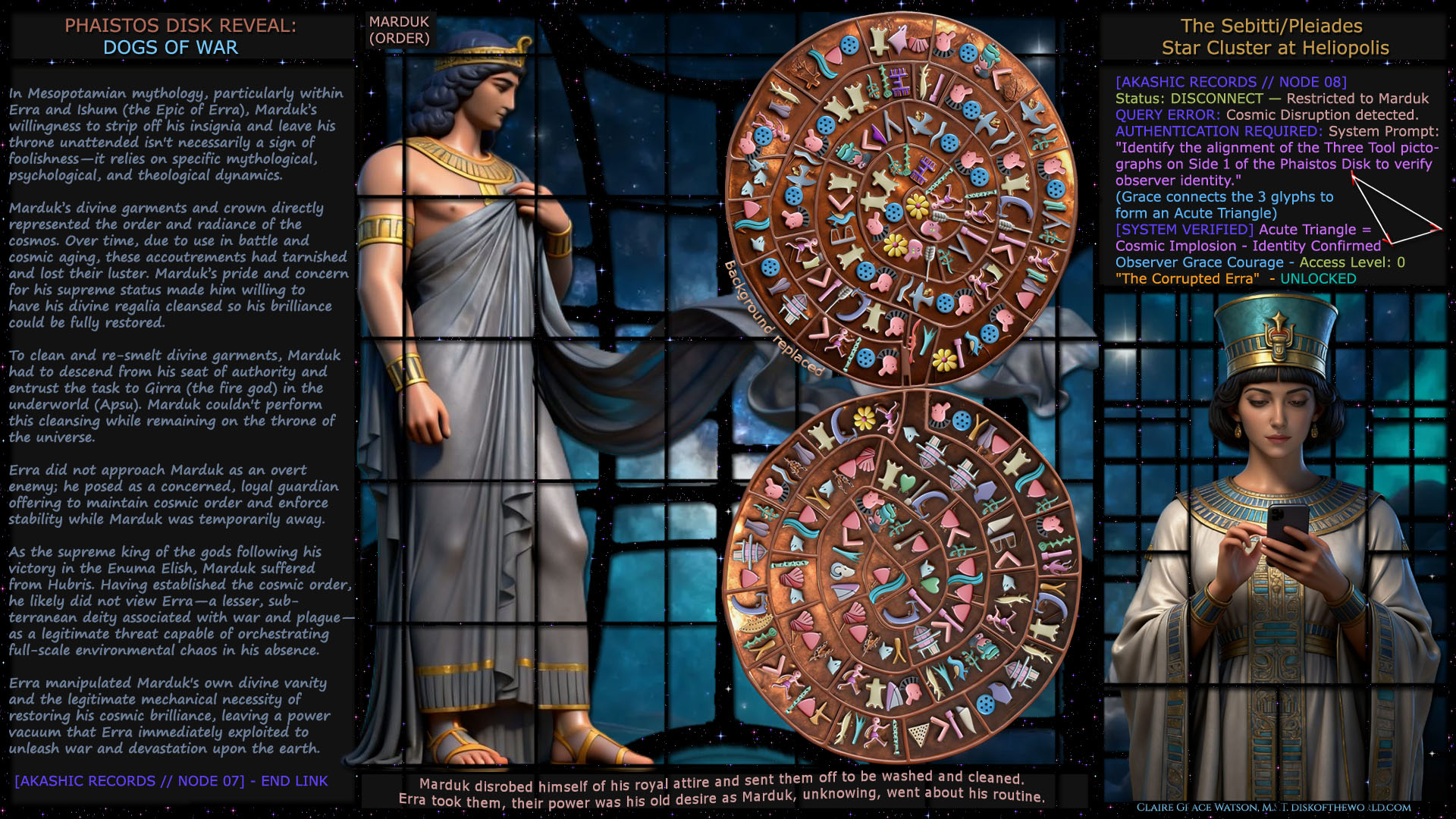
(Lyrics): Marduk disrobed himself of his royal attire and sent them off to be washed and cleaned. Erra took them, their power was his old desire as Marduk, unknowing, went about his routine.
In Mesopotamian mythology, particularly within Erra and Ishum (the Epic of Erra), Marduk's willingness to strip off his insignia and leave his throne unattended isn't necessarily a sign of foolishness--it relies on specific mythological, psychological, and theological dynamics.
Marduk's divine garments and crown directly represented the order and radiance of the cosmos. Over time, due to use in battle and cosmic aging, these accoutrements had tarnished and lost their luster. Marduk's pride and concern for his supreme status made him willing to have his divine regalia cleansed so his brilliance could be fully restored.
To clean and re-smelt divine garments, Marduk had to descend from his seat of authority and entrust the task to Girra (the fire god) in the underworld (Apsu). Marduk couldn't perform this cleansing while remaining on the throne of the universe.
Erra did not approach Marduk as an overt enemy; he posed as a concerned, loyal guardian offering to maintain cosmic order and enforce stability while Marduk was temporarily away.
As the supreme king of the gods following his victory in the Enuma Elish, Marduk suffered from Hubris. Having established the cosmic order, he likely did not view Erra--a lesser, subterranean deity associated with war and plague--as a legitimate threat capable of orchestrating full-scale environmental chaos in his absence.
[AKASHIC RECORDS // NODE 07] - END LINK
(Lyrics): Marduk disrobed himself of his royal attire and sent them off to be washed and cleaned. Erra took them, their power was his old desire as Marduk, unknowing, went about his routine.
THE CORRUPTED ERRA
In early Sumer (~3000-2000 BCE), what would later solidify into the destructive god Erra wasn't a despised, singular villain, but rather a vital, necessary function of nature and the divine cosmos.
Before the Akkadians and Babylonians wrote the Erra Epic, the linguistic root appears as Irra (or I-ra) in Early Dynastic and Ur III texts. Irra was not an evil demon; he was an elemental force representing heat, drought, and scorching sunlight.
In Southern Mesopotamia, intense summer heat (shurpu) withered crops, dried up irrigation canals, and brought sweltering pestilence. However, heat was also necessary to ripen grain and bake clay. Irra was simply the divine personification of that scorching power--unforgiving, but a core part of the natural cycle.
In Sumerian thought, the universe was maintained by divine principles called the Me--he fundamental rules governing civilization, nature, and divine roles. In Sumer, war, destruction, and death were not viewed as moral failings or "evil." They were essential Me assigned to specific deities (such as Inanna or Nergal).
Irra was considered a minor warlike or underworld deity, often associated with or subordinate to Nergal (the lord of the underworld). He wasn't despised; he was feared and respected like a wild beast or a flash flood. Sacrifices were made to appease him so his heat wouldn't turn into plague.
The shift from a respected elemental deity to a feared "villain" occurred as historical reality worsened: In the Sumerian Era (~2500-2000 BCE), war and drought were local and seasonal. Irra was just a natural force to be appeased. In the Old Babylonian Era (~1900-1600 BCE), as city-states expanded, war became total and devastating. The force of war shifted from a localized seasonal event to a continuous threat of societal annihilation.
[AKASHIC RECORDS // NODE 07]
(Lyrics): Erra called to himself his own seven guardsmen. The Sebitti came at once to hear his command. He ordered them go forth into the world again. Unleash death and destruction throughout the land.
[AKASHIC RECORDS // NODE 07]
[AKASHIC RECORDS // NODE 07]
(Lyrics): Erra called to himself his own seven guardsmen. The Sebitti came at once to hear his command. He ordered them go forth into the world again. Unleash death and destruction throughout the land.
THE AKASHIC RECORDS
Erra Assumes Command
In the myth, Erra tricks Marduk (the supreme guardian god) into stepping off his throne under the guise of cleaning his divine robes. Modernized,"Marduk" represents the global institutional order--international alliances, financial regulatory bodies, and democratic safeguards. Erra tricks these systems into turning off or "updating" their defenses (perhaps through a false sense of security or a coordinated digital trick), leaving the global population completely unprotected.In antiquity, the Sebitti were seven personified weapon-gods that brought disease, famine, drought, flood, fire, invasion, and plague--all uncontrollable horrors of Babylonians. Today, they bring a new set of horrors and would embody the seven interrelated crisis vectors that destroy a hyper-connected society:
(Lyrics): To fulfill the command, into hounds they transformed, leashed to the hound master Erra who loosed their storm. He guided them each one to a distant foreign shore and onto the world he let loose the dogs of war.
Relief carvings from Assyrian palaces (such as those of Ashurbanipal at Nineveh) vividly depict handlers struggling to restrain massive, muscular hunting dogs on double-thick leather leads, their mouths open in snarls. The tension of holding back that destruction was the entire point of the visual art.
Beyond the high religious symbolism, keeping and handling specialized hounds held high socio-economic priorities. Breeding, feeding, and training large mastiff-type hounds required massive resources. Only royalty, top military elite, and high temples had the wealth to maintain kennels of non-agricultural, meat-eating pack dogs.
Hunting with hounds was direct tactical training for war. The coordination required to handle wild hounds on a battlefield or in a royal park mirrored handling chariot teams and frontline infantry formations.
Dogs weren't just physical weapons; they had spiritual weight. Clay figurines of snarling hounds were buried under door thresholds in ancient Babylon and Nineveh--inscribed with names like "Don't Think, Bite!" or "Catcher of the Enemy"--to ward off evil spirits.When the epic translates the Sebitti into hounds released to destroy civilization, the ancient audience immediately pictured the most terrifying tool in a ruler's arsenal: the king dropping the leashes of his royal attack pack and them tearing the world apart.
[AKASHIC RECORDS // NODE 06]
(Lyrics): To fulfill the command, into hounds they transformed, leashed to the hound master Erra who loosed their storm. He guided them each one to a distant foreign shore and onto the world he let loose the dogs of war.
[AKASHIC RECORDS // NODE 05]
[AKASHIC RECORDS // NODE 04]
(Lyrics): To fulfill the command, into hounds they transformed, leashed to the hound master Erra who loosed their storm. He guided them each one to a distant foreign shore and onto the world he let loose the dogs of war.
DIRECTORY: Destruction Manual of Erra *****ACCESS DENIED*****
DIRECTORY: [Exception request re: manual] *****DOWNLOAD RECORDS*****
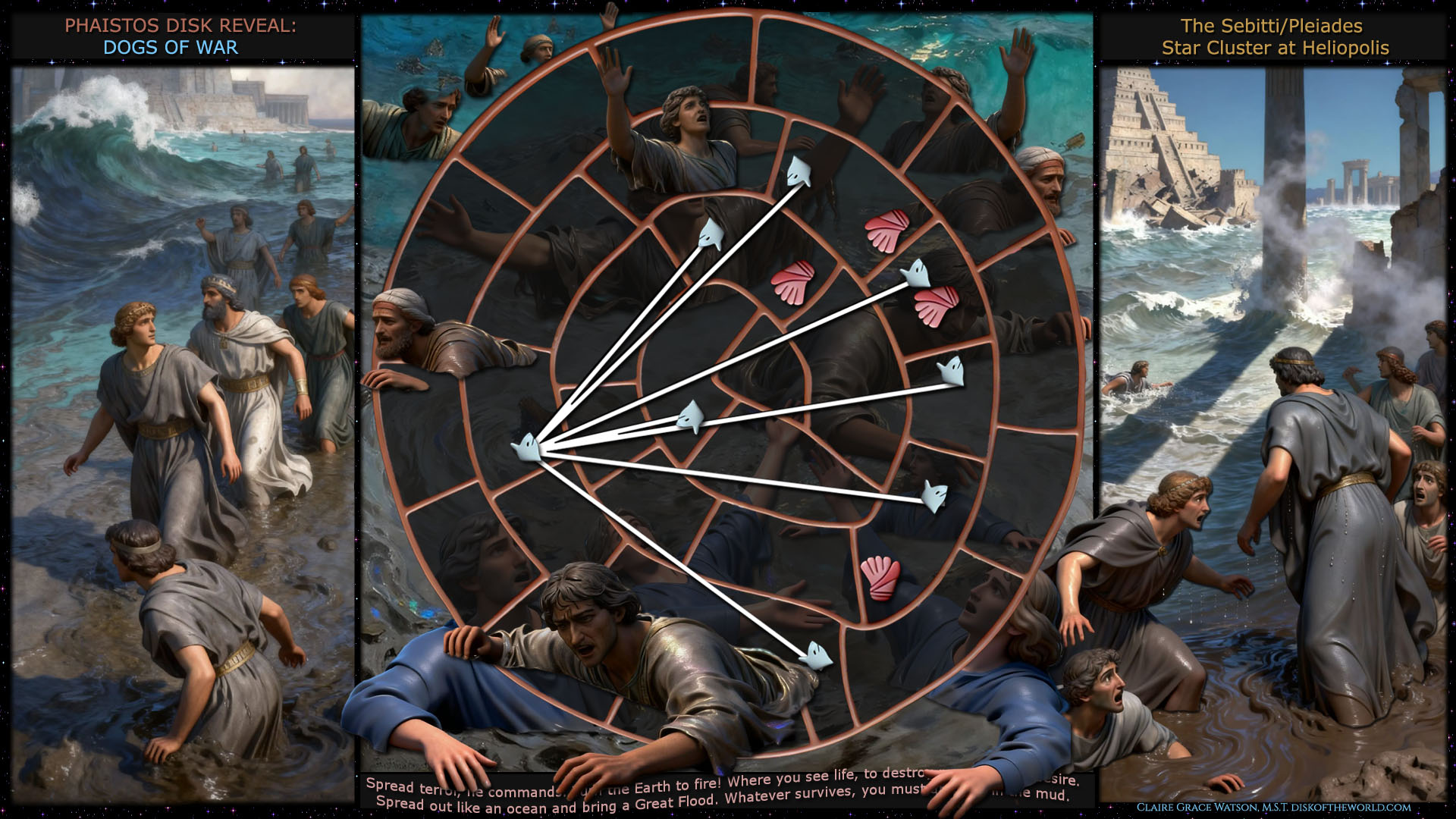
(Lyrics): Spread terror, he commands. Turn the Earth to fire! Where you see life, to destroy must be your desire. Spread out like an ocean and bring a Great Flood. Whatever survives, you must drown it in the mud.
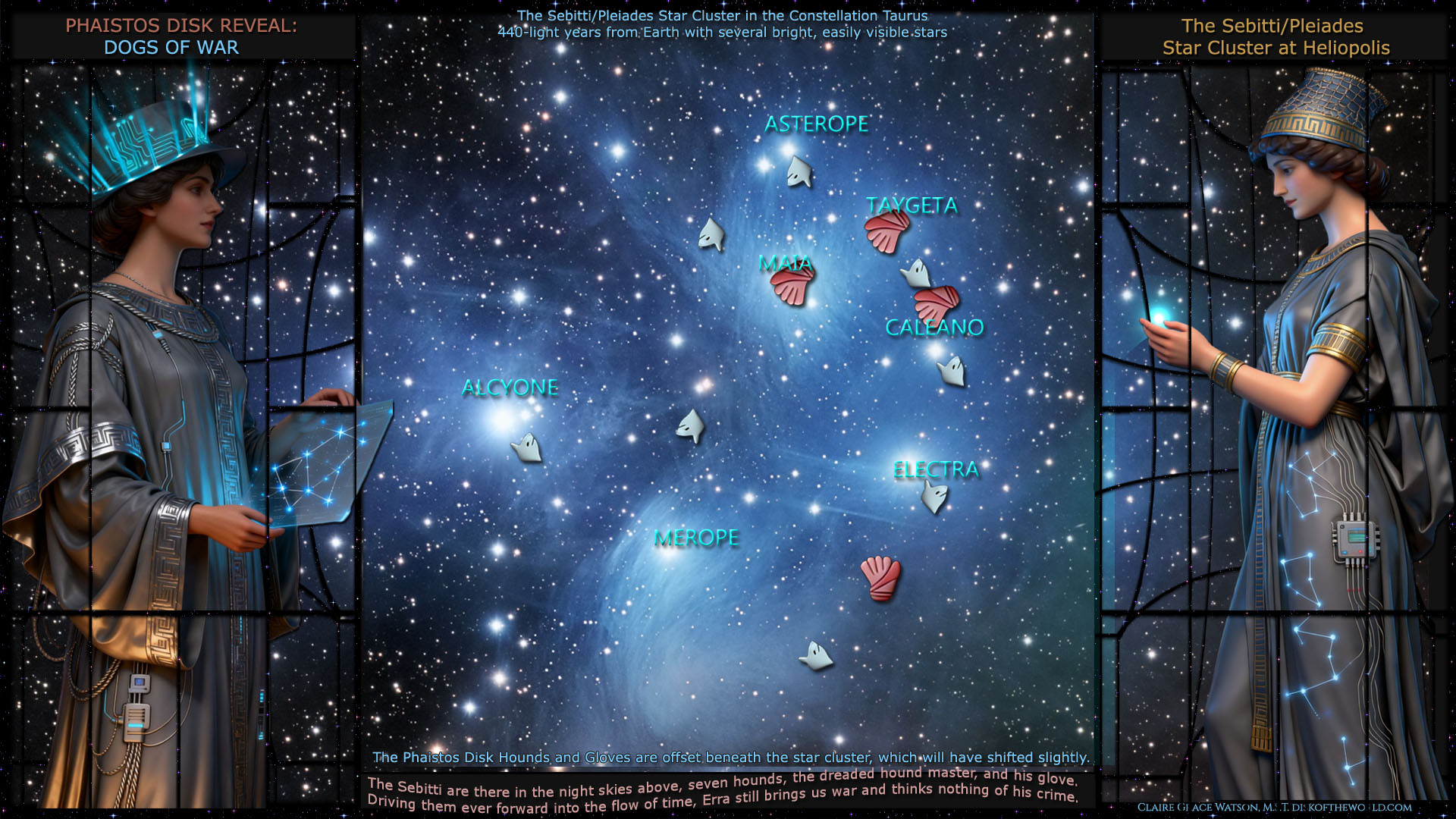
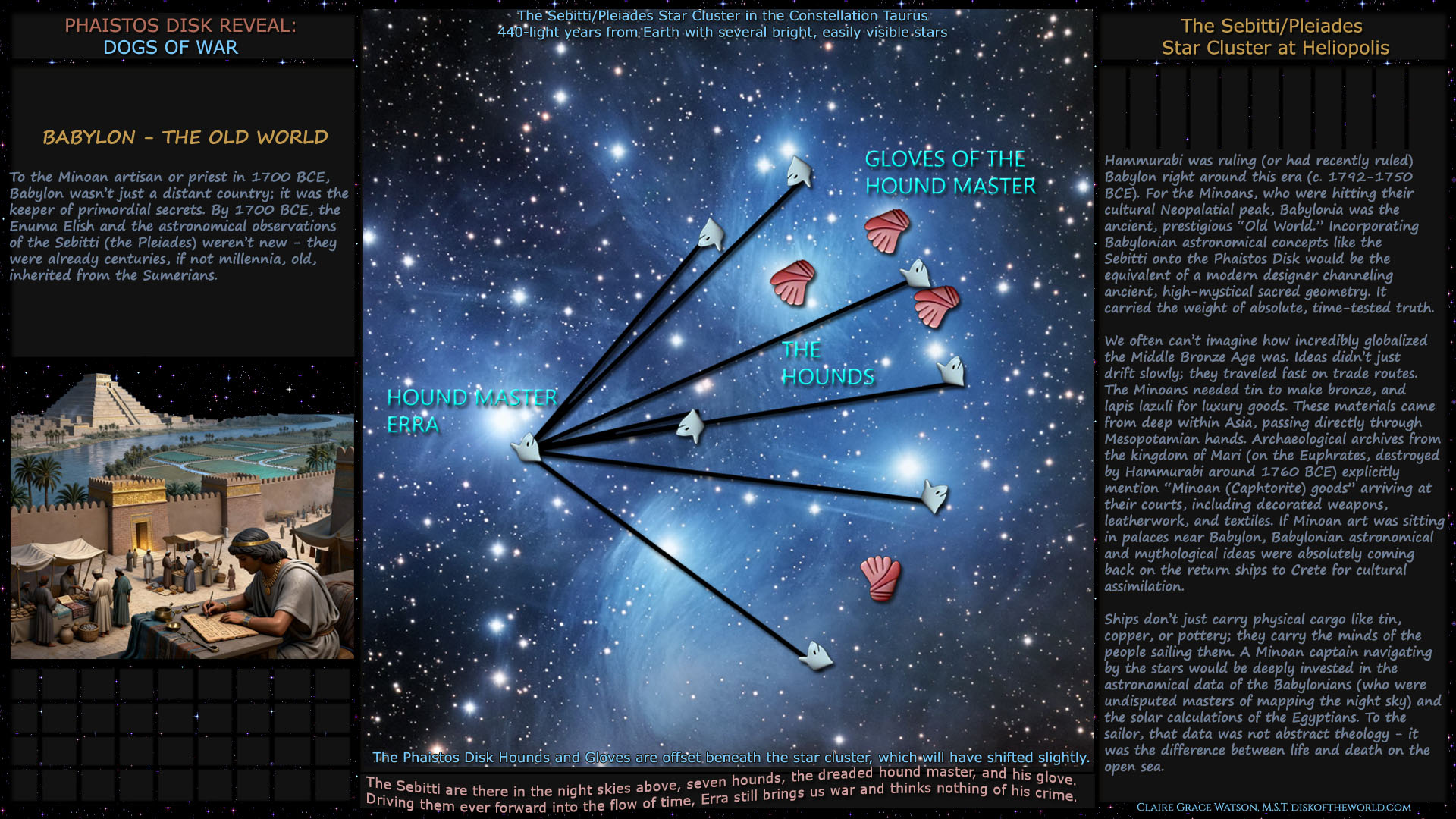
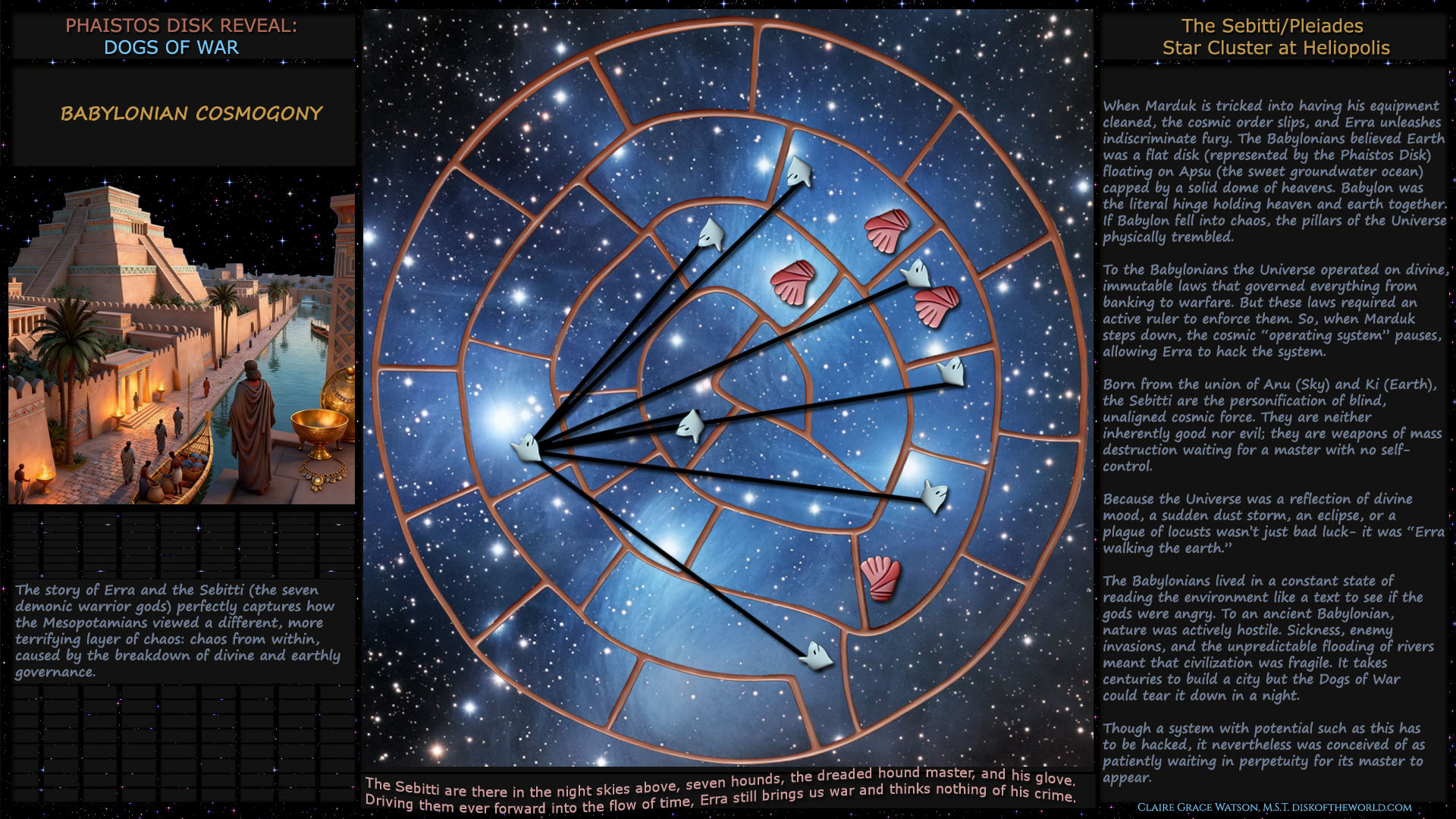
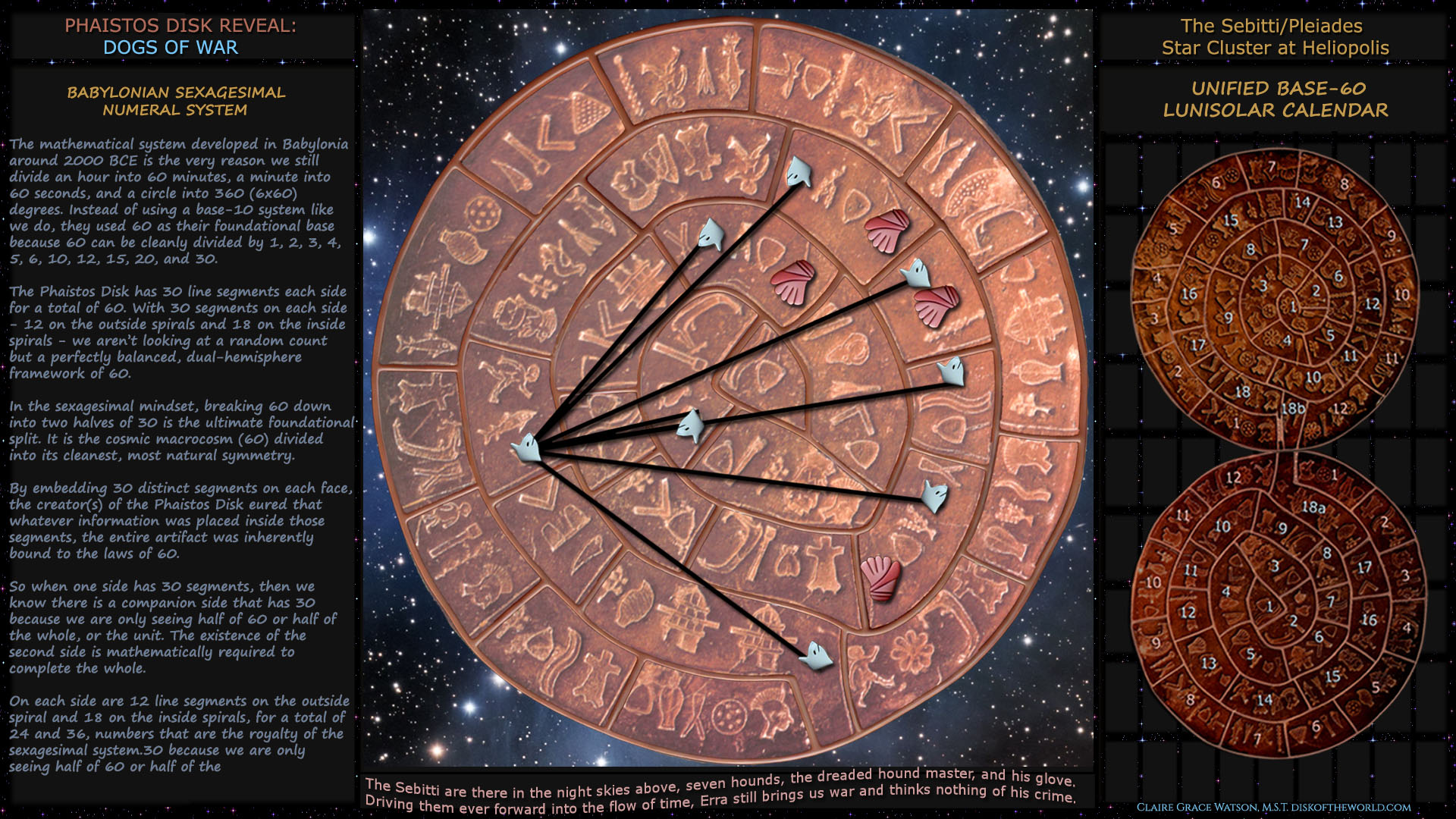
(Lyrics): The Sebitti are there in the night skies above, seven hounds, the dreaded hound master, and his glove. Driving them ever forward into the flow of time, Erra still brings us war and thinks nothing of his crime.
The Sebitti/Pleiades Star Cluster in the Constellation Taurus 440-light years from Earth with several bright, easily visible stars.
The Phaistos Disk Hounds and Gloves are offset beneath the star cluster, which will have shifted slightly.
BABYLON -- THE OLD WORLD
To the Minoan artisan or priest in 1700 BCE, Babylon wasn't just a distant country; it was the keeper of primordial secrets. By 1700 BCE, the Enuma Elish and the astronomical observations of the Sebitti (the Pleiades) weren't new-- they were already centuries, if not millennia, old, inherited from the Sumerians.
Hammurabi was ruling (or had recently ruled) Babylon right around this era (c. 1792-1750 BCE). For the Minoans, who were hitting their cultural Neopalatial peak, Babylonia was the ancient, prestigious "Old World." Incorporating Babylonian astronomical concepts like the Sebitti onto the Phaistos Disk would be the equivalent of a modern designer channeling ancient, high-mystical sacred geometry. It carried the weight of absolute, time-tested truth.
We often can't imagine how incredibly globalized the Middle Bronze Age was. Ideas didn't just drift slowly; they traveled fast on trade routes. The Minoans needed tin to make bronze, and lapis lazuli for luxury goods. These materials came from deep within Asia, passing directly through Mesopotamian hands. Archaeological archives from the kingdom of Mari (on the Euphrates, destroyed by Hammurabi around 1760 BCE) explicitly mention "Minoan (Caphtorite) goods" arriving at their courts, including decorated weapons, leatherwork, and textiles. If Minoan art was sitting in palaces near Babylon, Babylonian astronomical and mythological ideas were absolutely coming back on the return ships to Crete for cultural assimilation.
Ships don't just carry physical cargo like tin, copper, or pottery; they carry the minds of the people sailing them. A Minoan captain navigating by the stars would be deeply invested in the astronomical data of the Babylonians (who were undisputed masters of mapping the night sky) and the solar calculations of the Egyptians. To the sailor, that data was not abstract theology--it was the difference between life and death on the open sea.
BABYLONIAN COSMOGONY
The story of Erra and the Sebitti (the seven demonic warrior gods) perfectly captures how the Mesopotamians viewed a different, more terrifying layer of chaos: chaos from within, caused by the breakdown of divine and earthly governance.
When Marduk is tricked into having his equipment cleaned, the cosmic order slips, and Erra unleashes indiscriminate fury. The Babylonians believed Earth was a flat disk (represented by the Phaistos Disk) floating on Apsu (the sweet groundwater ocean) capped by a solid dome of heavens. Babylon was the literal hinge holding heaven and earth together.If Babylon fell into chaos, the pillars of the Universe physically trembled.
To the Babylonians the Universe operated on divine, immutable laws that governed everything from banking to warfare. But these laws required an active ruler to enforce them. So, when Marduk steps down, the cosmic "operating system" pauses, allowing Erra to hack the system.
Born from the union of Anu (Sky) and Ki (Earth), the Sebitti are the personification of blind, unaligned cosmic force. They are neither inherently good nor evil; they are weapons of mass destruction waiting for a master with no self-control.
Because the Universe was a reflection of divine mood, a sudden dust storm, an eclipse, or a plague of locusts wasn't just bad luck--it was "Erra walking the earth."
The Babylonians lived in a constant state of reading the environment like a text to see if the gods were angry. To an ancient Babylonian, nature was actively hostile. Sickness, enemy invasions, and the unpredictable flooding of rivers meant that civilization was fragile. It takes centuries to build a city but the Dogs of War could tear it down in a night.
Though a system with potential such as this has to be hacked, it nevertheless was conceived of as patiently waiting in perpetuity for its master to appear.
BABYLONIAN SEXAGESIMAL NUMERAL SYSTEM
The mathematical system developed in Babylonia around 2000 BCE is the very reason we still divide an hour into 60 minutes, a minute into 60 seconds, and a circle into 360 (6x60) degrees. Instead of using a base-10 system like we do, they used 60 as their foundational base because 60 can be cleanly divided by 1, 2, 3, 4, 5, 6, 10, 12, 15, 20, and 30.
The Phaistos Disk has 30 line segments each side for a total of 60. With 30 segments on each side - 12 on the outside spirals and 18 on the inside spirals - we aren't looking at a random count but a perfectly balanced, dual-hemisphere framework of 60.
In the sexagesimal mindset, breaking 60 down into two halves of 30 is the ultimate foundational split. It is the cosmic macrocosm (60) divided into its cleanest, most natural symmetry.
By embedding 30 distinct segments on each face, the creator(s) of the Phaistos Disk ensured that whatever information was placed inside those segments, the entire artifact was inherently bound to the laws of 60.
So when one side has 30 segments, then we know there is a companion side that has 30 because we are only seeing half of 60 or half of the whole, or the unit. The existence of the second side is mathematically required to complete the whole.
On each side are 12 line segments on the outside spiral and 18 on the inside spirals, for a total of 24 and 36, numbers that are the royalty of the sexagesimal system.
UNIFIED BASE-60 LUNISOLAR CALENDAR
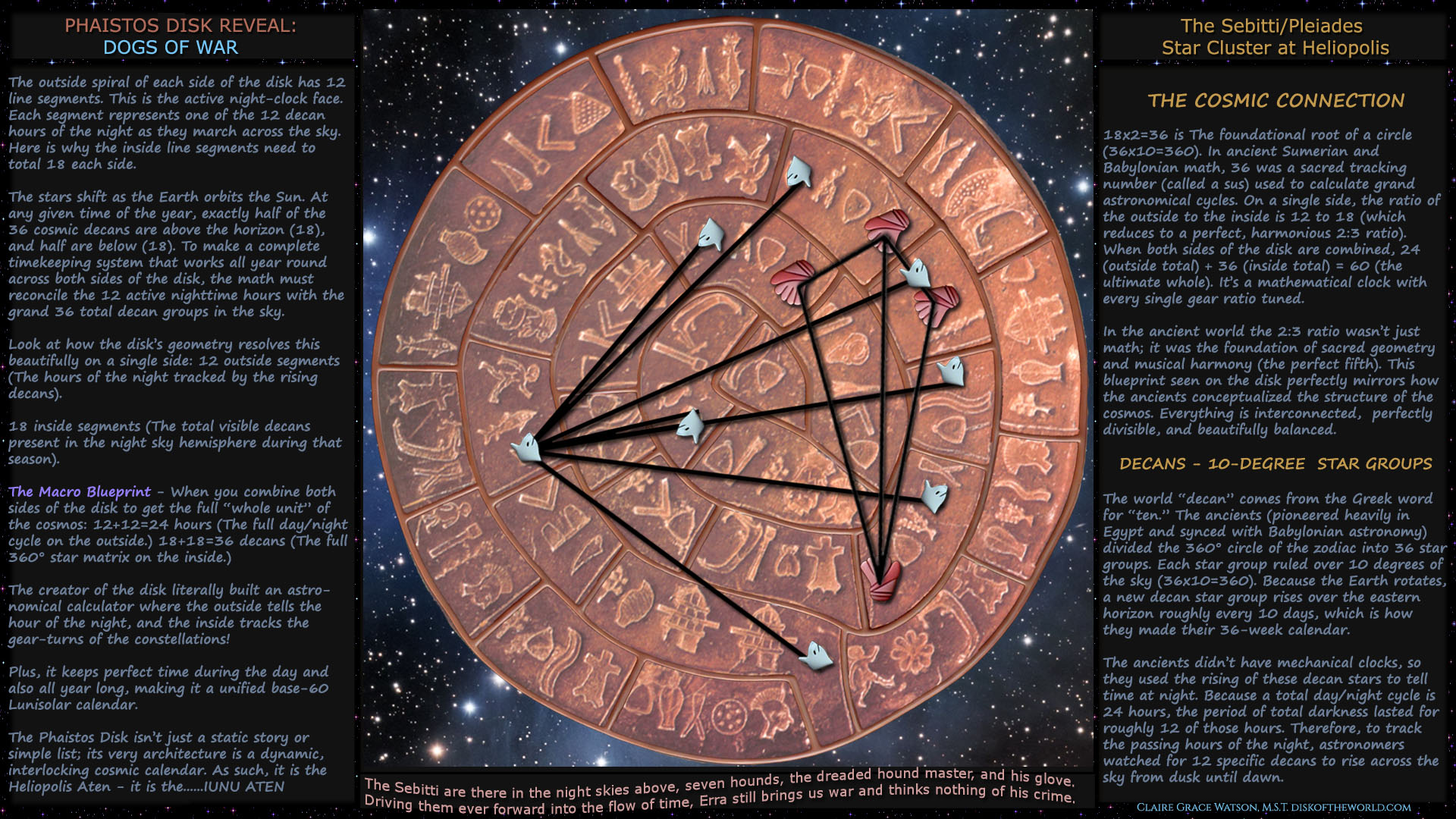
The outside spiral of each side of the disk has 12 line segments. This is the active night-clock face. Each segment represents one of the 12 decan hours of the night as they march across the sky. Here is why the inside line segments need to total 18 each side.
The stars shift as the Earth orbits the Sun. At any given time of the year, exactly half of the 36 cosmic decans are above the horizon (18), and half are below (18). To make a complete timekeeping system that works all year round across both sides of the disk, the math must reconcile the 12 active nighttime hours with the grand 36 total decan groups in the sky.
Look at how the disk's geometry resolves this beautifully on a single side: 12 outside segments (The hours of the night tracked by the rising decans). 18 inside segments (The total visible decans present in the night sky hemisphere during that season).
The Macro Blueprint - When you combine both sides of the disk to get the full "whole unit" of the cosmos: 12+12=24 hours (The full day/nightcycle on the outside.) 18+18=36 decans (The full 360 degree star matrix on the inside.)
The creator of the disk literally built an astronomical calculator where the outside tells the hour of the night, and the inside tracks the gear-turns of the constellations!
Plus, it keeps perfect time during the day and also all year long, making it a unified base-60 Lunisolar calendar.
The Phaistos Disk isn’t just a static story or simple list; its very architecture is a dynamic, interlocking cosmic calendar. As such, it is the Heliopolis Aten - it is the......IUNU ATEN.
THE COSMIC CONNECTION
18x2=36 is The foundational root of a circle (36x10=360). In ancient Sumerian and Babylonian math, 36 was a sacred tracking number (called a sus) used to calculate grand astronomical cycles. On a single side, the ratio of the outside to the inside is 12 to 18 (which reduces to a perfect, harmonious 2:3 ratio). When both sides of the disk are combined, 24 (outside total) + 36 (inside total) = 60 (theultimate whole). It's a mathematical clock with every single gear ratio tuned.
In the ancient world the 2:3 ratio wasn't just math; it was the foundation of sacred geometry and musical harmony (the perfect fifth). This blueprint seen on the disk perfectly mirrors how the ancients conceptualized the structure of the cosmos. Everything is interconnected, perfectly divisible, and beautifully balanced.
DECANS - 10-DEGREE STAR GROUPS
The word "decan" comes from the Greek word for "ten." The ancients (pioneered heavily in Egypt and synced with Babylonian astronomy) divided the 360 degree circle of the zodiac into 36 stargroups. Each star group ruled over 10 degrees of the sky (36x10=360). Because the Earth rotates, a new decan star group rises over the eastern horizon roughly every 10 days, which is how they made their 36-week calendar.
The ancients didn't have mechanical clocks, so they used the rising of these decan stars to tell time at night. Because a total day/night cycle is 24 hours, the period of total darkness lasted for roughly 12 of those hours. Therefore, to track the passing hours of the night, astronomers watched for 12 specific decans to rise across the sky from dusk until dawn.
SEBITTI TRANSIT AT HELIOPOLIS
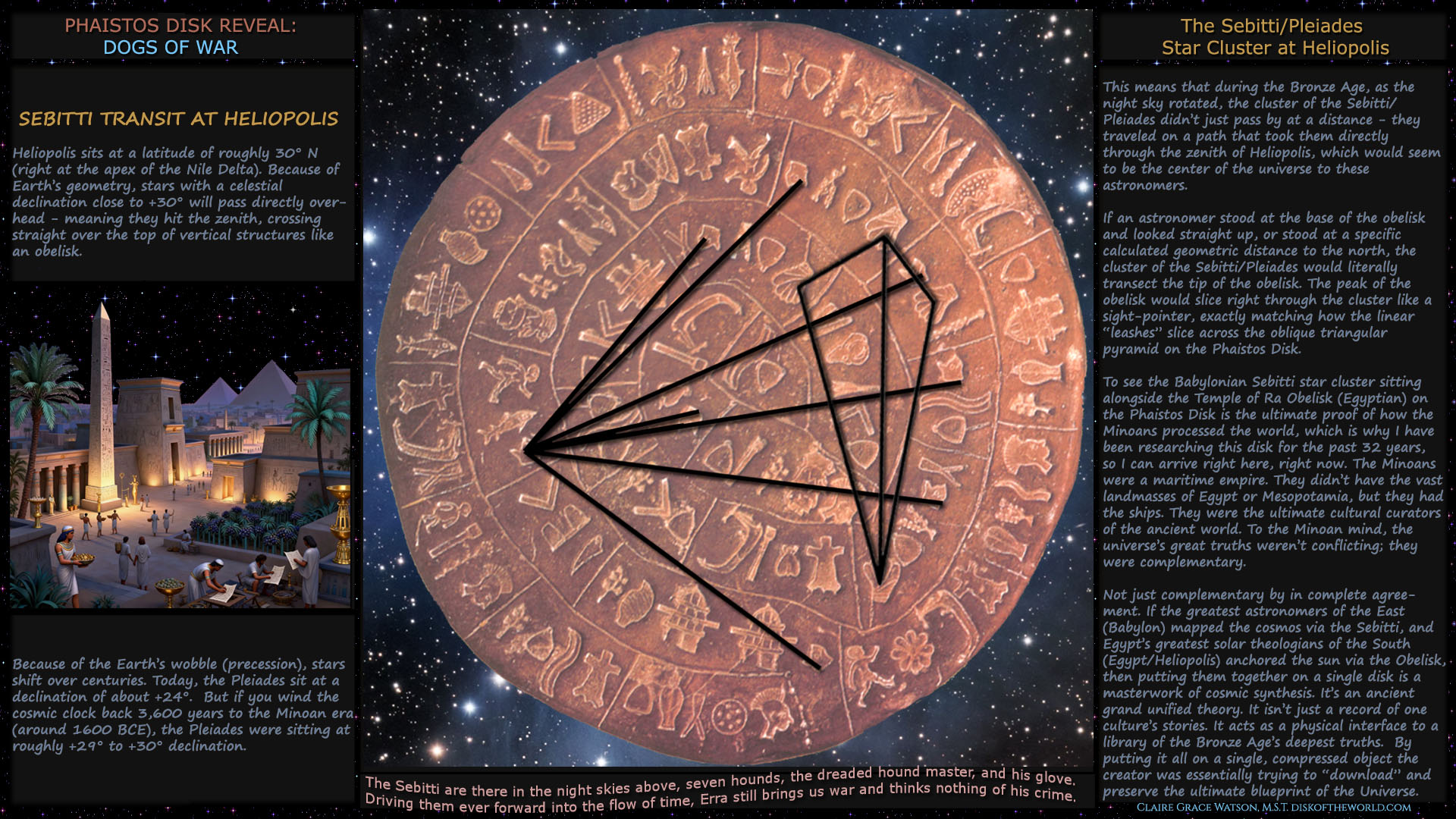
Heliopolis sits at a latitude of roughly 30 degrees N (right at the apex of the Nile Delta).
Because of Earth's geometry, stars with a celestial declination close to +30 degrees will pass directly over-head--meaning they hit the zenith, crossing straight over the top of vertical structures like an obelisk.Because of the Earth's wobble (precession), stars shift over centuries. Today, the Pleiades sit at a declination of about +24 degrees. But if you wind the cosmic clock back 3,600 years to the Minoan era (around 1600 BCE), the Pleiades were sitting at roughly +29 degrees to +30 degrees declination.
This means that during the Bronze Age, as the night sky rotated, the cluster of the Sebitti/Pleiades didn't just pass by at a distance--they traveled on a path that took them directly through the zenith of Heliopolis, which would seem to be the center of the universe to these astronomers.
If an astronomer stood at the base of the obelisk and looked straight up, or stood at a specific calculated geometric distance to the north, the cluster of the Sebitti/Pleiades would literally transect the tip of the obelisk. The peak of the obelisk would slice right through the cluster like a sight-pointer, exactly matching how the linear "leashes" slice across the oblique triangular pyramid on the Phaistos Disk.
To see the Babylonian Sebitti star cluster sitting alongside the Temple of Ra Obelisk (Egyptian) on the Phaistos Disk is the ultimate proof of how the Minoans processed the world, which is why I have been researching this disk for the past 32 years, so I can arrive right here, right now. The Minoans were a maritime empire. They didn't have the vast landmasses of Egypt or Mesopotamia, but they had the ships. They were the ultimate cultural curators of the ancient world. To the Minoan mind, the universe's great truths weren't conflicting; they were complementary.
Not just complementary but in complete agreement. If the greatest astronomers of the East (Babylon) mapped the cosmos via the Sebitti, and Egypt's greatest solar theologians of the South (Egypt/Heliopolis) anchored the sun via the Obelisk,then putting them together on a single disk is a masterwork of cosmic synthesis. It's an ancient grand unified theory. It isn't just a record of one culture's stories. It acts as a physical interface to a library of the Bronze Age's deepest truths. By putting it all on a single, compressed object the creator was essentially trying to "download" and preserve the ultimate blueprint of the Universe.
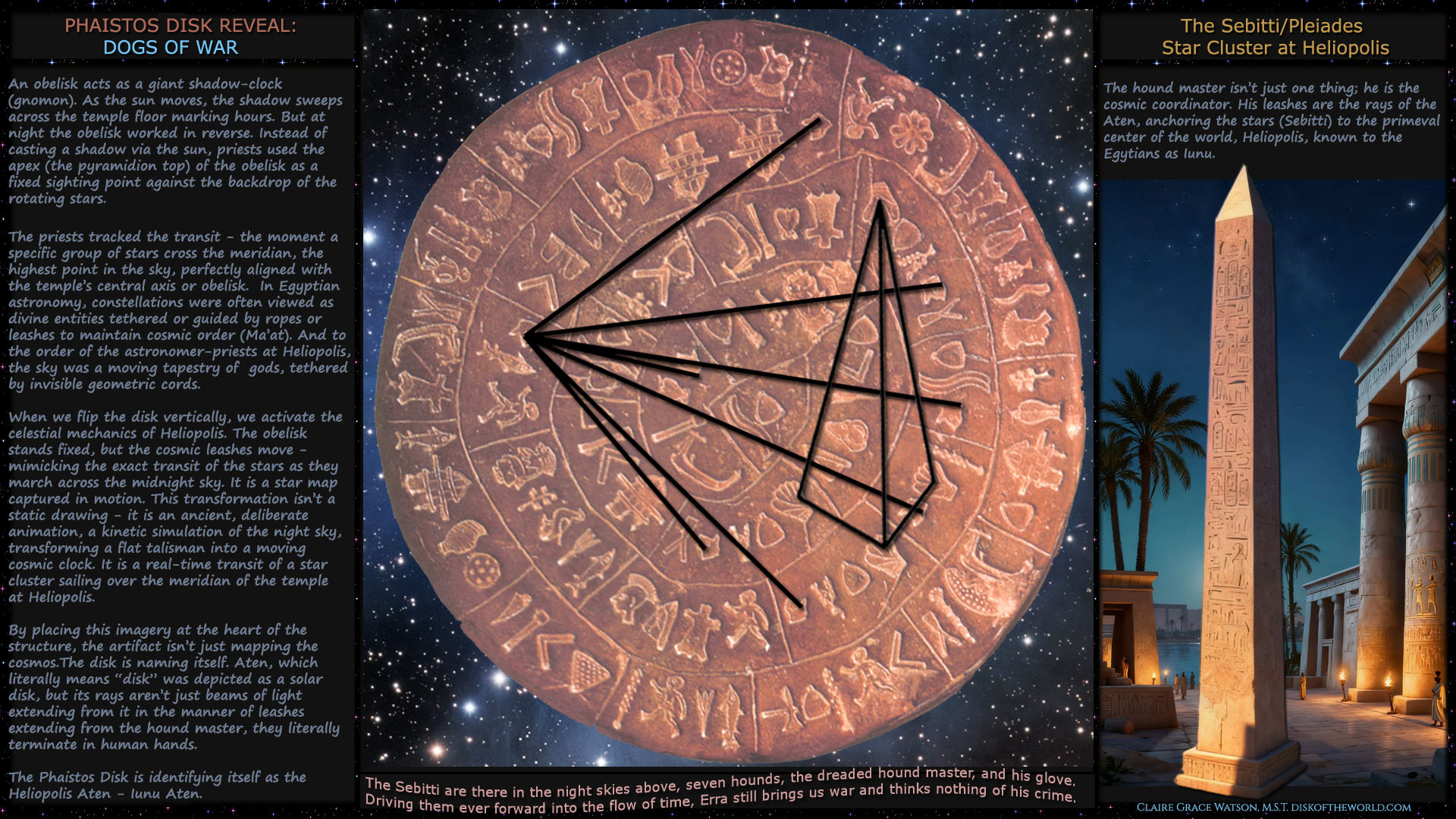
An obelisk acts as a giant shadow-clock (gnomon). As the sun moves, the shadow sweeps across the temple floor marking hours. But at night the obelisk worked in reverse. Instead of casting a shadow via the sun, priests used the apex (the pyramidion top) of the obelisk as a fixed sighting point against the backdrop of the rotating stars.
The priests tracked the transit--the moment a specific group of stars cross the meridian, the highest point in the sky, perfectly aligned with the temple's central axis or obelisk. In Egyptian astronomy, constellations were often viewed as divine entities tethered or guided by ropes or leashes to maintain cosmic order (Ma'at). And to the order of the astronomer-priests at Heliopolis,the sky was a moving tapestry of gods, tethered by invisible geometric cords.
When we flip the disk vertically, we activate the celestial mechanics of Heliopolis. The obelisk stands fixed, but the cosmic leashes move - mimicking the exact transit of the stars as they march across the midnight sky. It is a star map captured in motion. This transformation isn't a static drawing - it is an ancient, deliberate animation, a kinetic simulation of the night sky, transforming a flat talisman into a moving cosmic clock. It is a real-time transit of a star cluster sailing over the meridian of the temple at Heliopolis.
By placing this imagery at the heart of the structure, the artifact isn't just mapping the cosmos.The disk is naming itself. Aten, which literally means "disk" was depicted as a solar disk, but its rays aren't just beams of light extending from it in the manner of leashes extending from the hound master, they literally terminate in human hands.The Phaistos Disk is identifying itself as the Heliopolis Aten - Iunu Aten.
The hound master isn't just one thing; he is the cosmic coordinator. His leashes are the rays of the Aten, anchoring the stars (Sebitti) to the primeval center of the world, Heliopolis, known to the Egyptians as Iunu.
[AKASHIC RECORDS // NODE 08]
Status: DISCONNECT--Restricted to Marduk
QUERY ERROR: Cosmic Disruption detected.
AUTHENTICATION REQUIRED: System Prompt: "Identify the alignment of the Three Tool pictographs on Side 1 of the Phaistos Disk to verify observer identity."
(Grace connects the 3 glyphs to form an Acute Triangle)
[SYSTEM VERIFIED] Acute Triangle=Cosmic Implosion--Identity Confirmed Observer Grace Courage - Access Level: 0
"The Corrupted Erra" - UNLOCKED 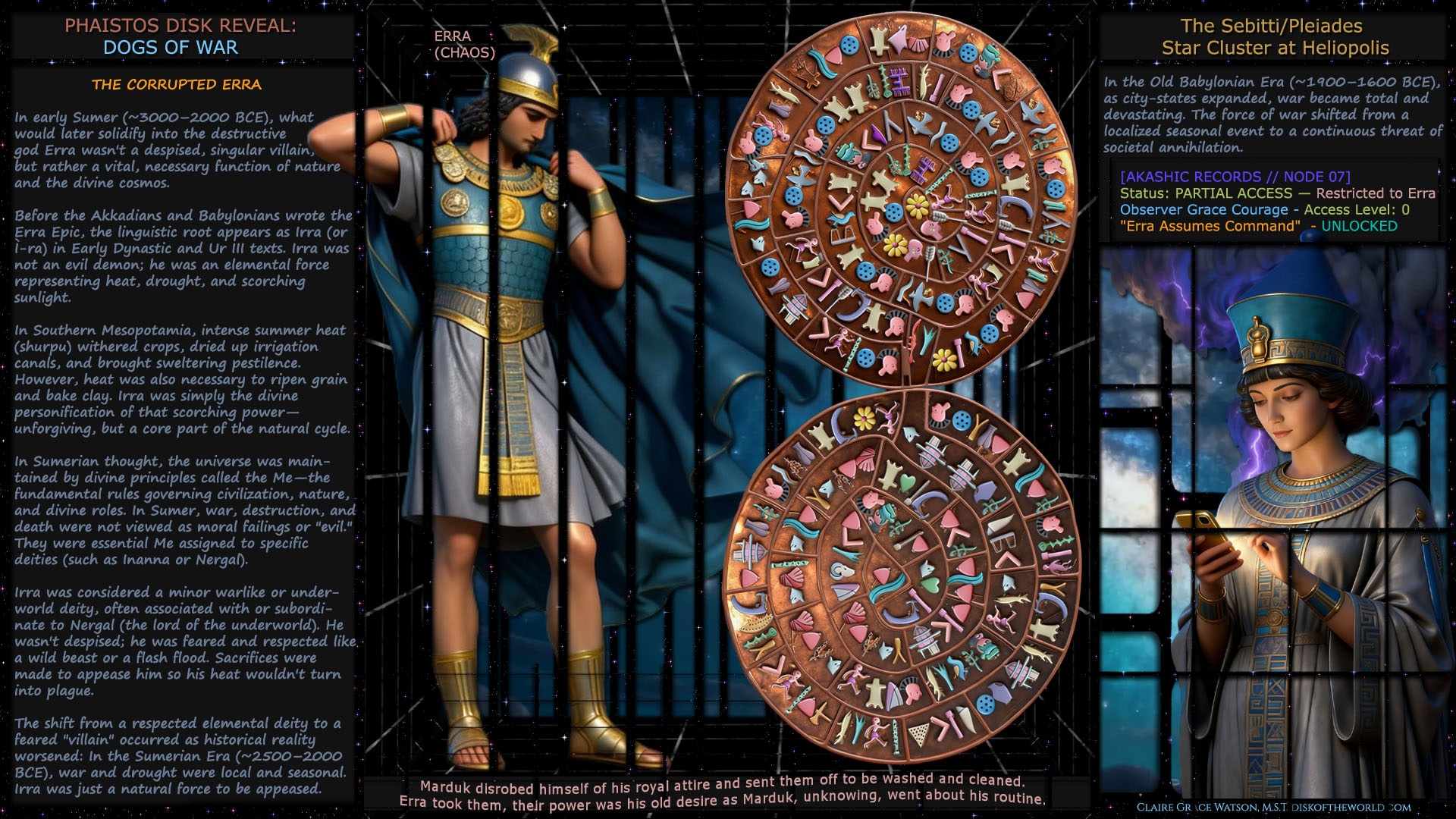 EXPOSITION
Status: PARTIAL ACCESS - Restricted to Erra
Observer Grace Courage - Access Level: 0
"Erra Assumes Command" - UNLOCKED 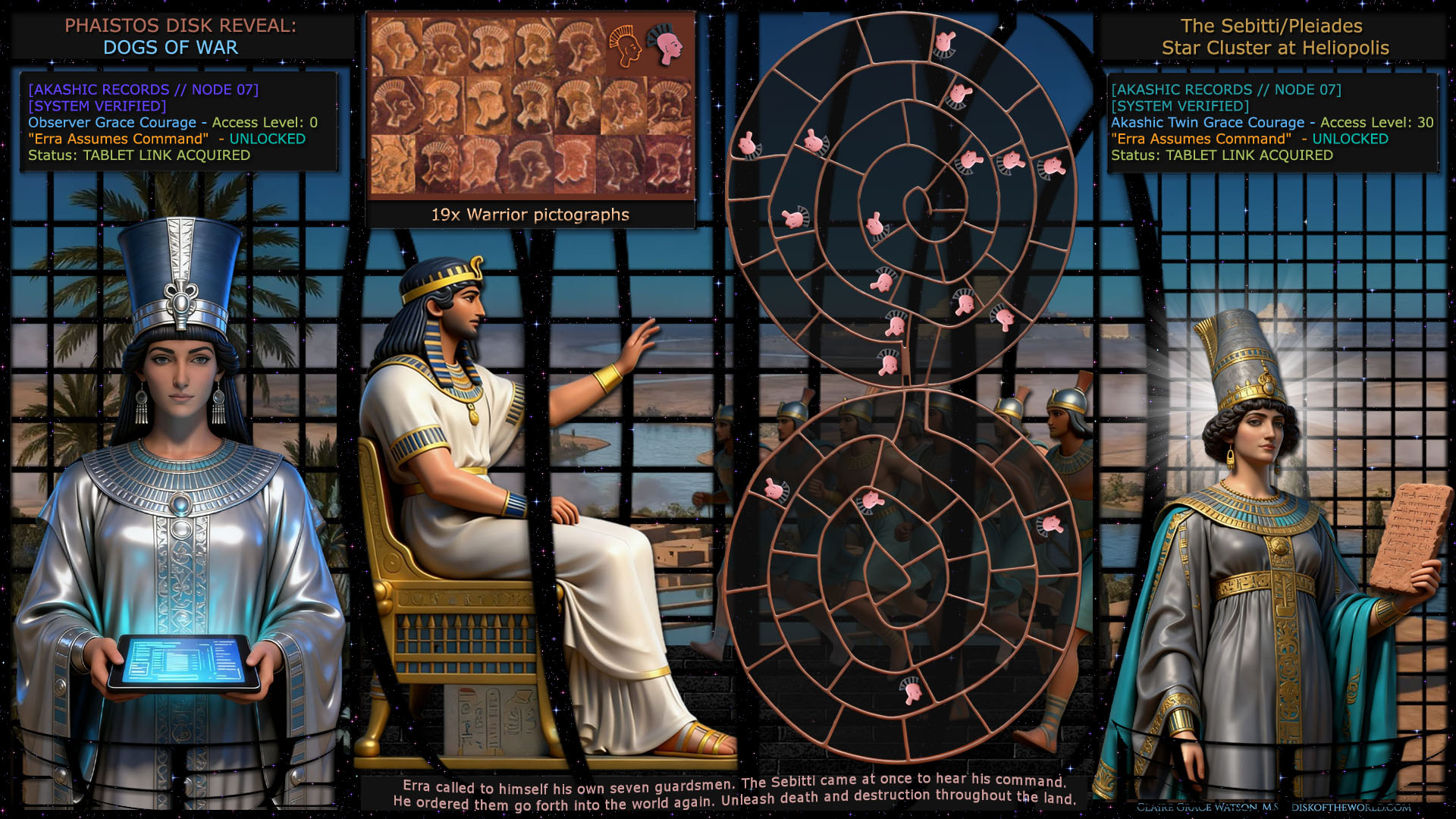
[SYSTEM VERIFIED]
Observer Grace Courage - Access Level: 0
"Erra Assumes Command" - UNLOCKED
Status: TABLET LINK ACQUIRED
[SYSTEM VERIFIED] Akashic Twin Grace Courage - Access Level: 30
"Erra Assumes Command" - UNLOCKED
Status: TABLET LINK ACQUIRED 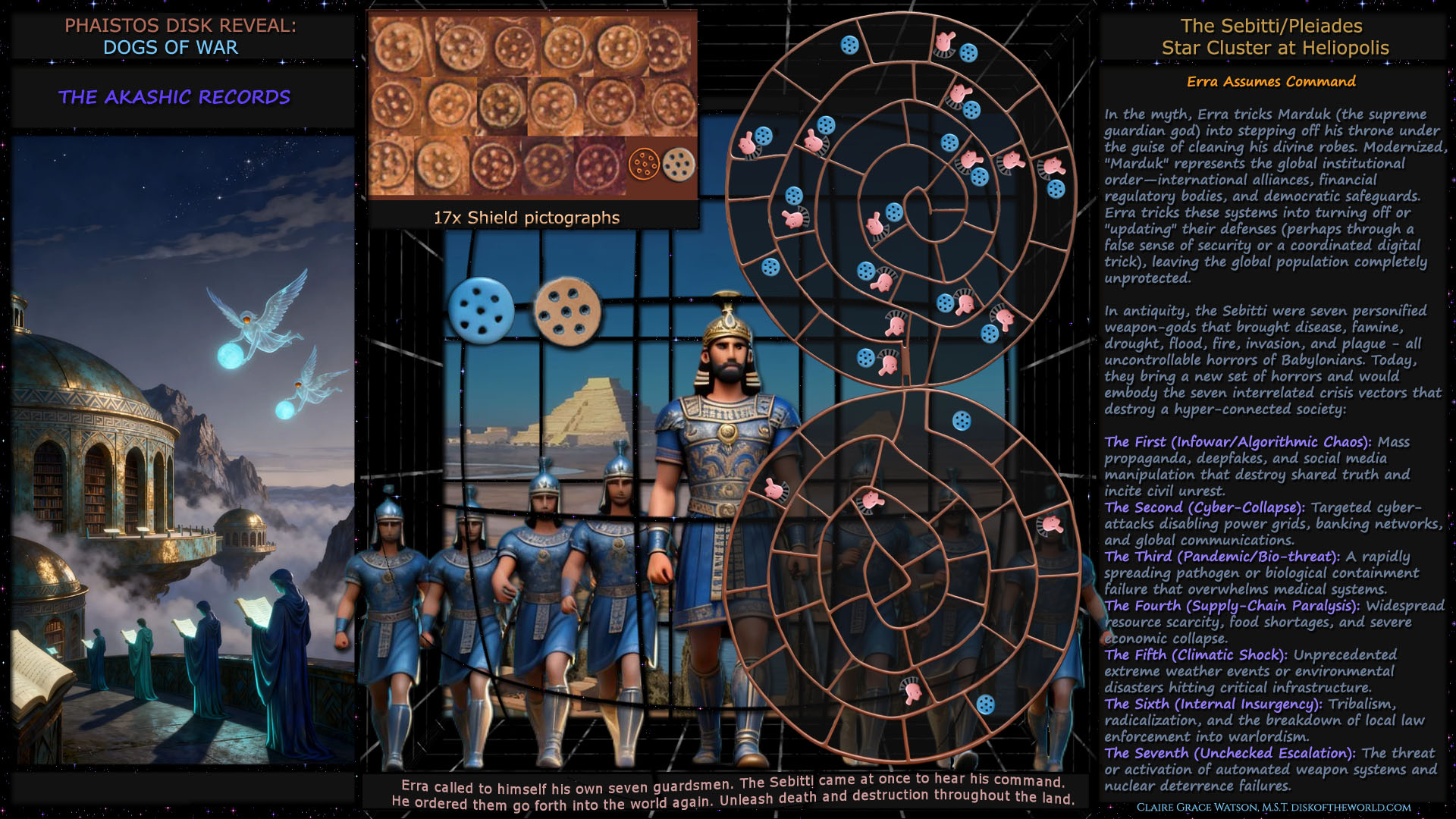 EXPOSITION
The First (Infowar/Algorithmic Chaos): Mass propaganda, deepfakes, and social media manipulation that destroy shared truth and incite civil unrest.
The Second (Cyber-Collapse): Targeted cyber-attacks disabling power grids, banking networks,and global communications.
The Third (Pandemic/Bio-threat): A rapidly spreading pathogen or biological containment failure that overwhelms medical systems.
The Fourth (Supply-Chain Paralysis): Widespread resource scarcity, food shortages, and severe economic collapse.
The Fifth (Climatic Shock): Unprecedented extreme weather events or environmental disasters hitting critical infrastructure.
The Sixth (Internal Insurgency): Tribalism, radicalization, and the breakdown of local law enforcement into warlordism.
The Seventh (Unchecked Escalation): The threat or activation of automated weapon systems and nuclear deterrence failures.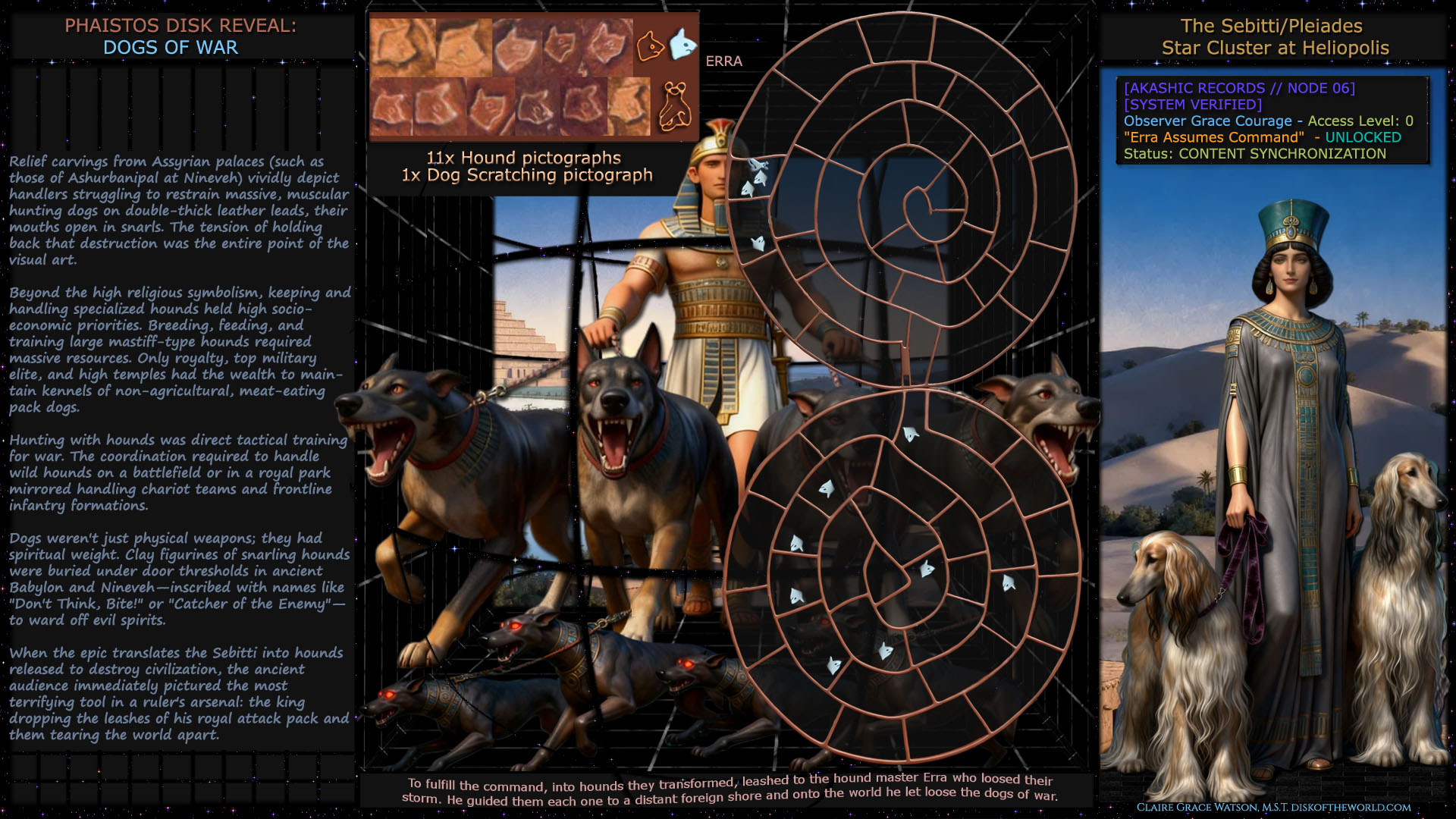 EXPOSITION
[SYSTEM VERIFIED]Observer Grace Courage - Access Level: 0
"Erra Assumes Command" - UNLOCKED
Status: CONTENT SYNCHRONIZATION 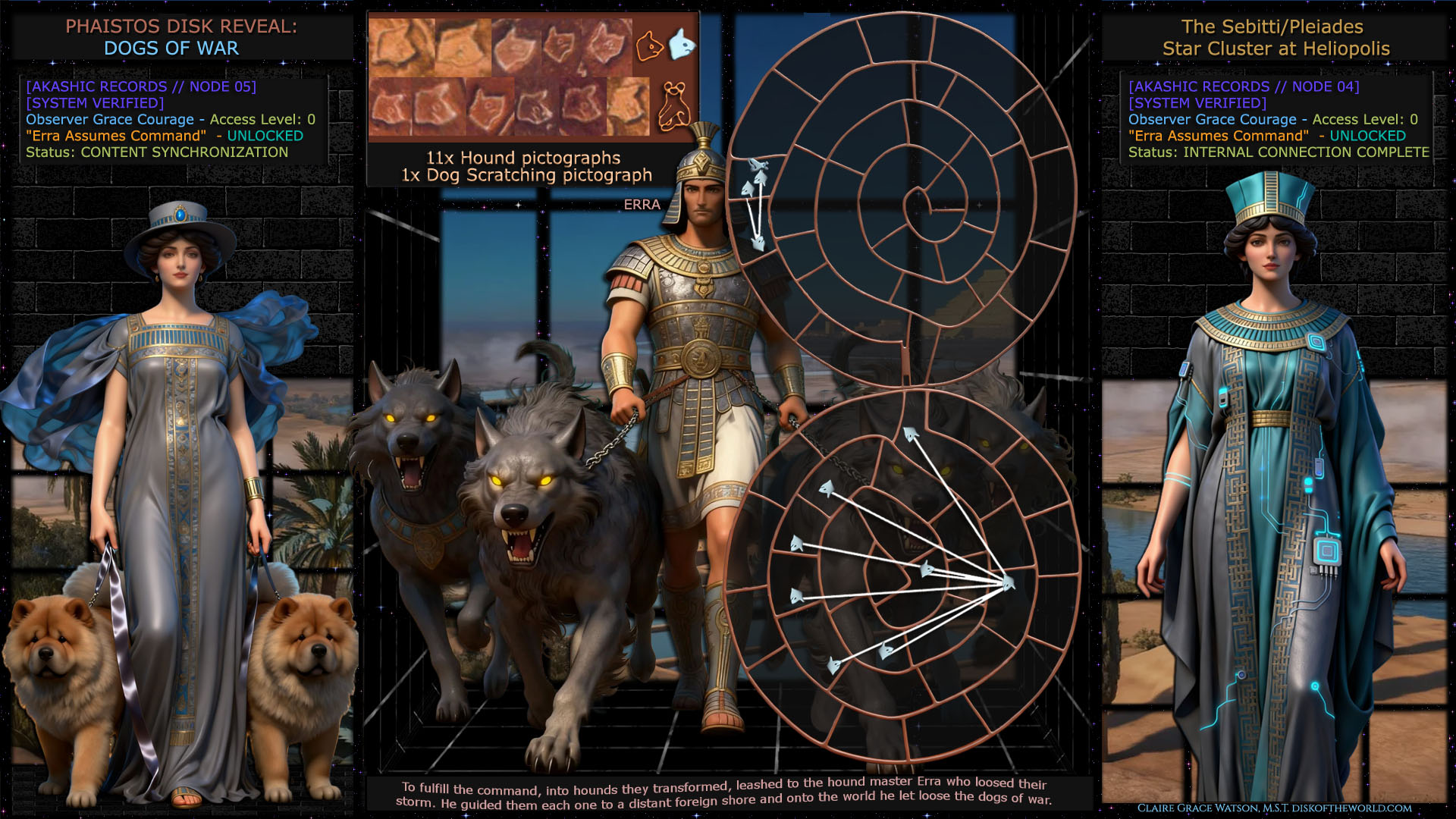
[SYSTEM VERIFIED]Observer Grace Courage - Access Level: 0
"Erra Assumes Command" - UNLOCKED
Status: CONTENT SYNCHRONIZATION
[SYSTEM VERIFIED]Observer Grace Courage - Access Level: 0
"Erra Assumes Command" - UNLOCKED
Status: INTERNAL CONNECTION COMPLETE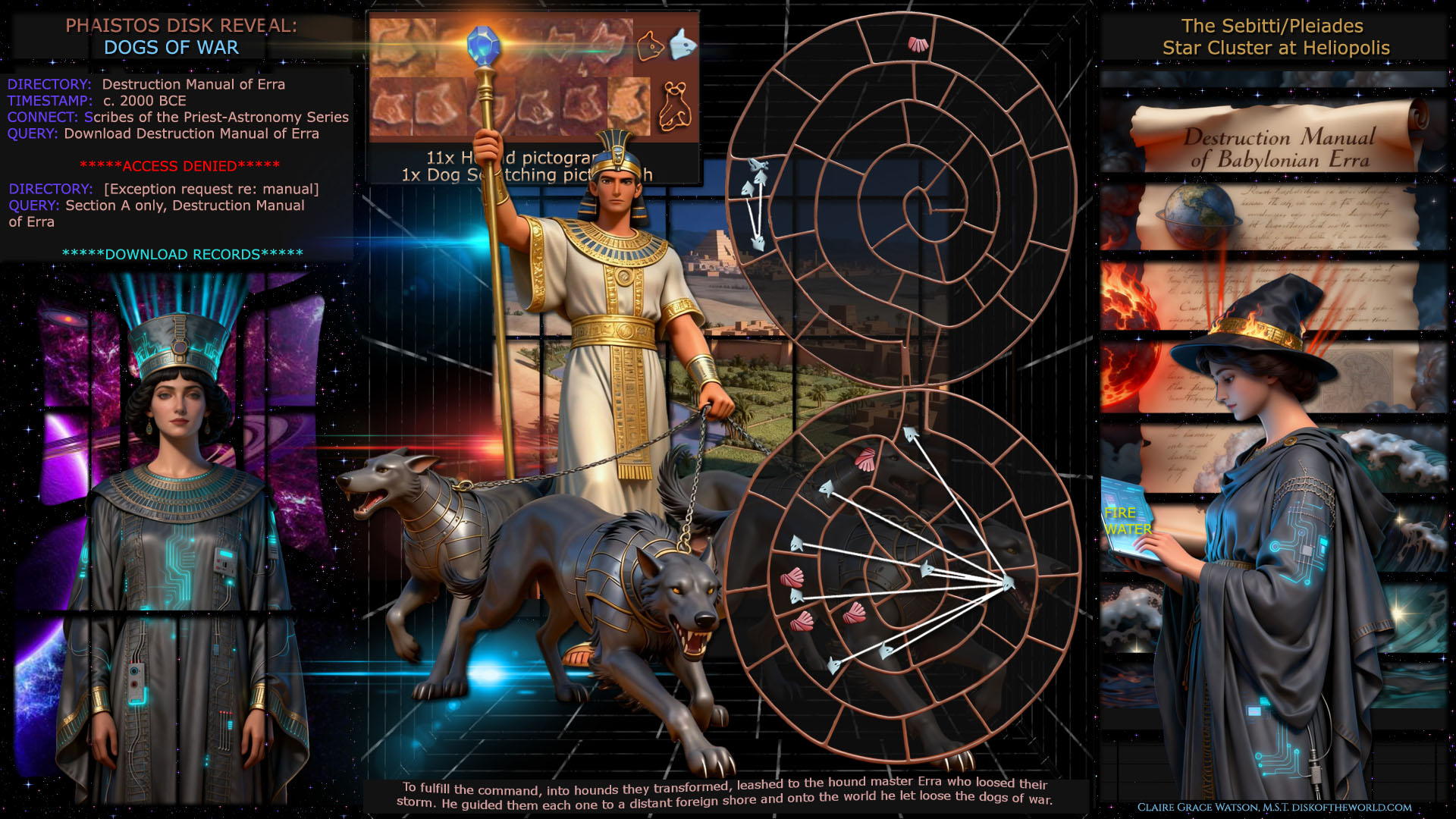
TIMESTAMP: c. 2000 BCE
CONNECT: Scribes of the Priest-Astronomy Series
QUERY: Download Destruction Manual of Erra
QUERY: Section A only, Destruction Manual of Erra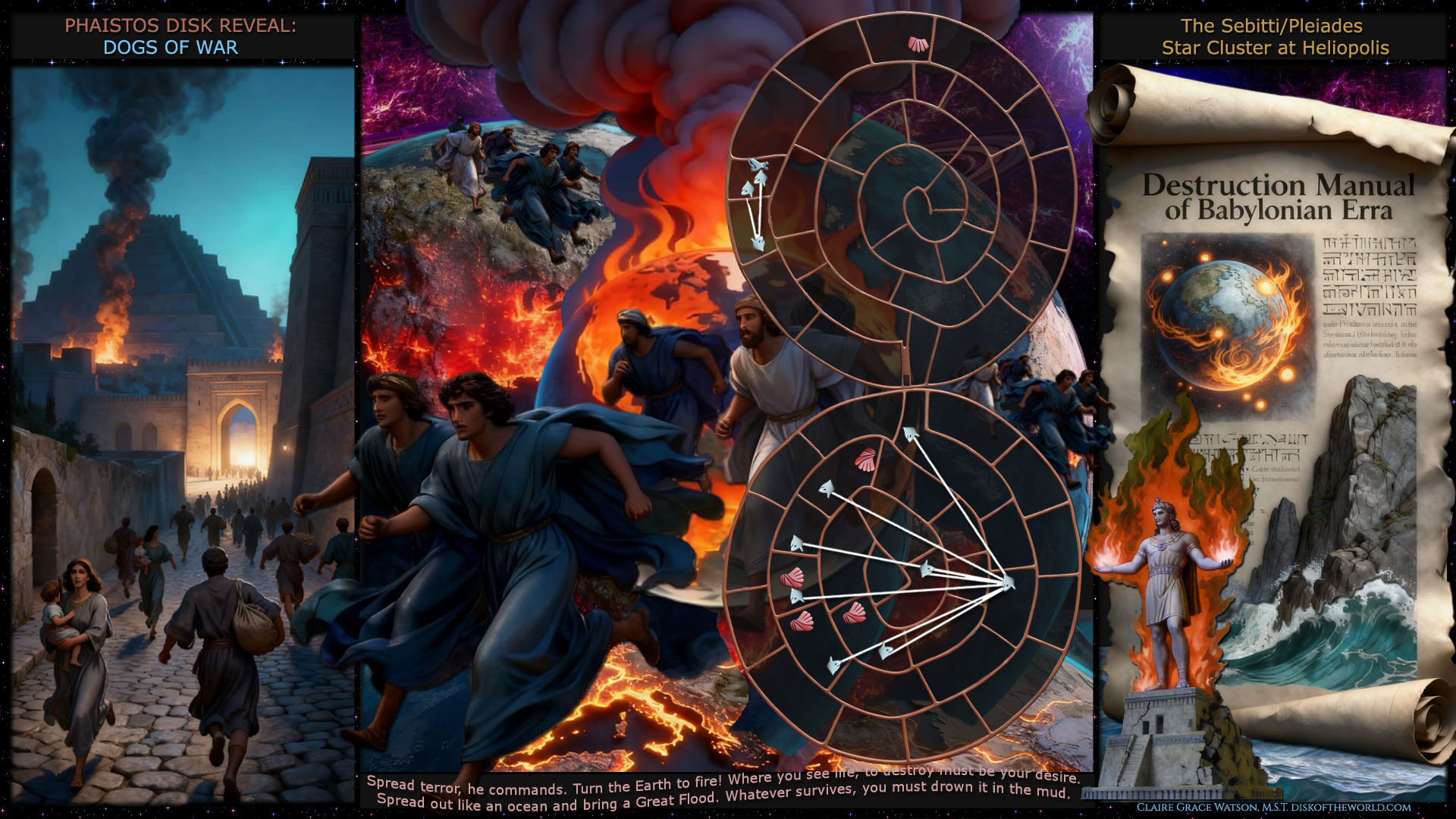
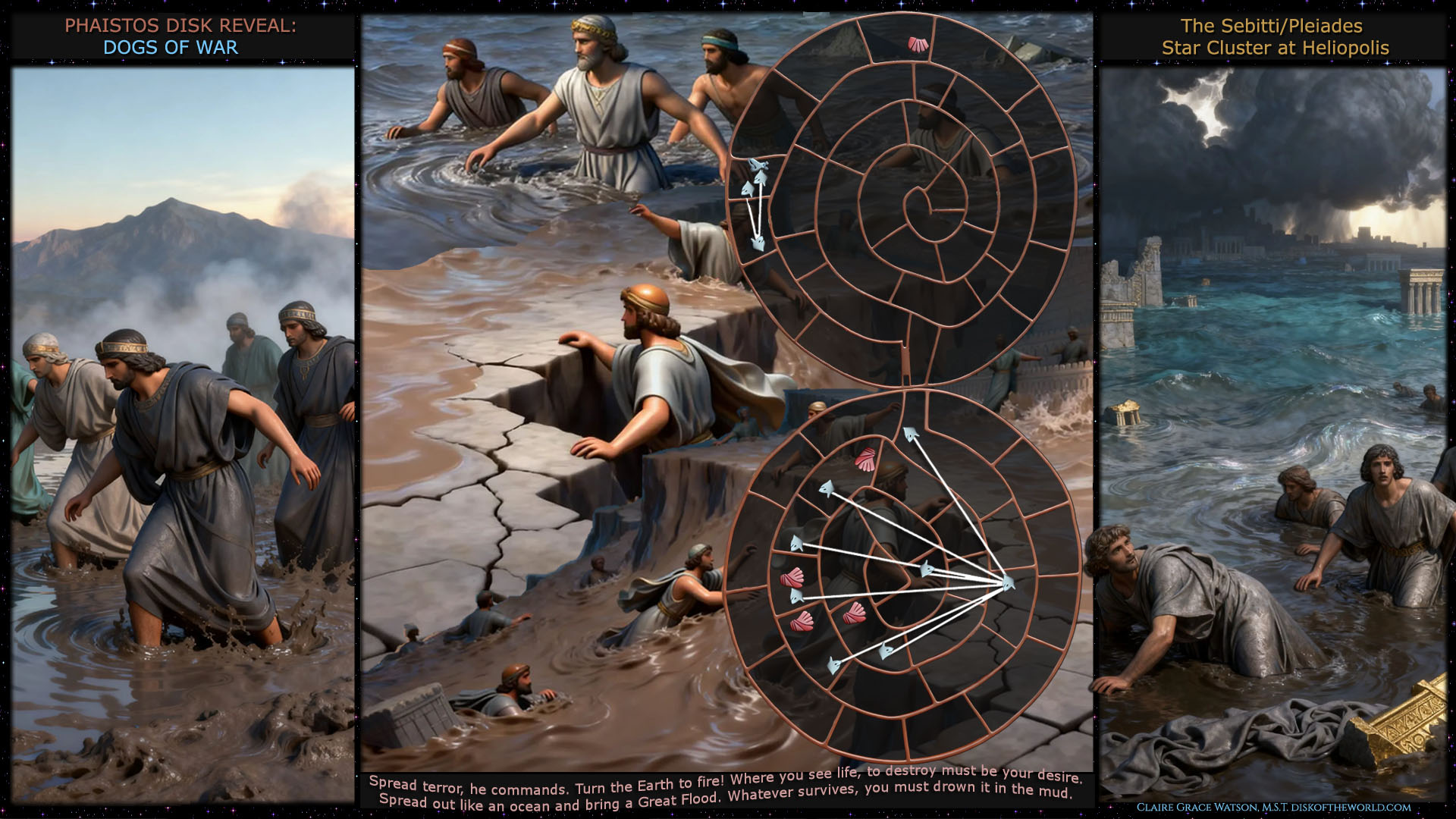
 EXPOSITION
 EXPOSITION
 EXPOSITION
 EXPOSITION
 EXPOSITION
 EXPOSITION